
LIFE 2026 draws a record 1,430 proposals and €4.3 billion in requests: what it means for applicants
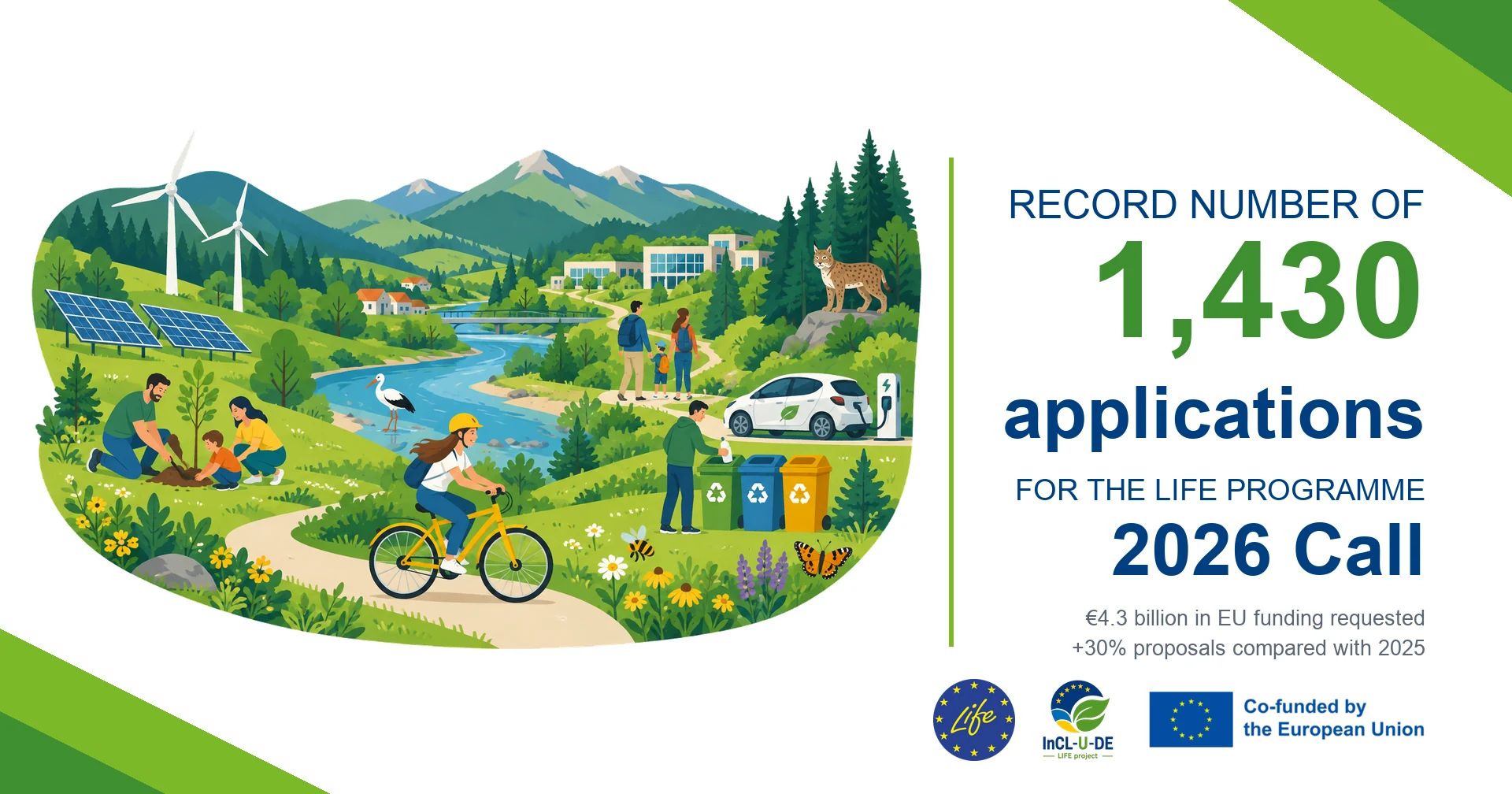
The 2026 LIFE call has set a new record. According to the European Climate, Infrastructure and Environment Executive Agency (CINEA), applicants submitted 1,430 project proposals requesting €4.3 billion in EU funding. The number of proposals rose by 30% compared with 2025, and the funding requested rose by 38%. All four sub-programmes saw growth.
This is the third record in a row. CINEA received 895 proposals in 2024 and 1,095 in 2025. We analysed the agency's official figures for 2021–2026 to show how demand for the programme is changing and where competition is rising fastest.
Demand has doubled in three years
Between 2021 and 2023, LIFE consistently received between 650 and 775 proposals a year. Growth accelerated sharply from 2024. In 2026 the programme received 2.2 times as many proposals as in 2023: 1,430 compared with 653.
Nature and Climate are growing fastest
| Sub-programme | 2025 | 2026 | Change |
|---|---|---|---|
| Nature & Biodiversity | 168 | 246 | +46.4% |
| Climate Change Mitigation & Adaptation | 260 | 373 | +43.5% |
| Circular Economy & Quality of Life | 348 | 448 | +28.7% |
| Clean Energy Transition | 319 | 363 | +13.8% |
| Total | 1,095 | 1,430 | +30.6% |
Nature & Biodiversity recorded the largest increase, up almost by half in a single year. Climate is growing almost as fast. Circular Economy & Quality of Life remains the largest sub-programme by number of proposals. Clean Energy Transition grew the least.
The structure of demand is shifting
Clean Energy Transition's share of all proposals fell from 36% in 2023 to 25% in 2026. Over the same period, the Climate sub-programme's share rose from 21% to 26%. Competition is therefore intensifying most in the environment and climate strands.
Funding requests are growing faster than proposal numbers
Since 2023, the EU contribution requested has grown 2.7-fold, from €1.6 billion to €4.3 billion. The average request per proposal has stayed at around €3 million since 2024. The record is therefore driven mainly by more applicants rather than by larger projects. In 2026 the average request edged up from €2.8 million to €3.0 million, which is why funding requests grew faster than the number of proposals.
Competition: roughly one in eight
The combined budget of the 31 LIFE 2026 calls is about €601.5 million, based on the official call documents. Applicants requested roughly seven times that amount. We estimate that the programme will fund around 165–180 project grants. That means roughly one proposal in eight, or about 12%, may receive funding. This is a preliminary estimate. CINEA will publish the official results in spring 2027.
What this means for Ukrainian applicants
- Quality matters more than ever. When demand is seven times the budget, funding goes to proposals with a clear environmental impact, measurable indicators and a convincing replication plan.
- Competition is tightest in Nature and Climate. Applicants in these sub-programmes should make an especially strong case for novelty, EU added value and sustainability of results.
- Clean Energy Transition remains relatively less crowded. It offers a 95% co-financing rate, and several topics accept a single applicant. The BUILD UP SKILLS topic explicitly lists Ukraine among its target countries.
- Preparation for 2027 should start now. Strong consortia, early partner contacts and a solid evidence base give applicants a clear advantage.
Next steps
CINEA will inform applicants of the results in spring 2027. Successful applicants are expected to sign grant agreements in summer 2027, with projects starting later that year.
LIFE has run for almost 35 years and has co-funded around 6,500 projects. Its budget for 2021–2027 exceeds €5.4 billion. Ukraine takes part in the programme as an associated country.
About InCL-U-DE
The LIFE InCL-U-DE project, "Integration through capacity building of the LIFE programme for the sustainable inclusion of Ukraine" (GA 101234369, LIFE25-CAP-UA), is implemented by Lviv Polytechnic National University from 1 June 2026 to 31 May 2029. The project helps Ukrainian organisations prepare competitive LIFE proposals through information sessions, consultations and call analysis.
Sources: CINEA, LIFE call submission results for 2021, 2022, 2023, 2024, 2025 and 2026. 2026 call budget and grant estimate: analysis by the Lviv Polytechnic Project Office based on official call documents. The 2021 Clean Energy Transition figure refers to the sub-programme's first call, which closed in January 2022.
Co-funded by the European Union
Co-funded by the European Union. Views and opinions expressed are however those of the author(s) only and do not necessarily reflect those of the European Union or CINEA. Neither the European Union nor the granting authority can be held responsible for them.